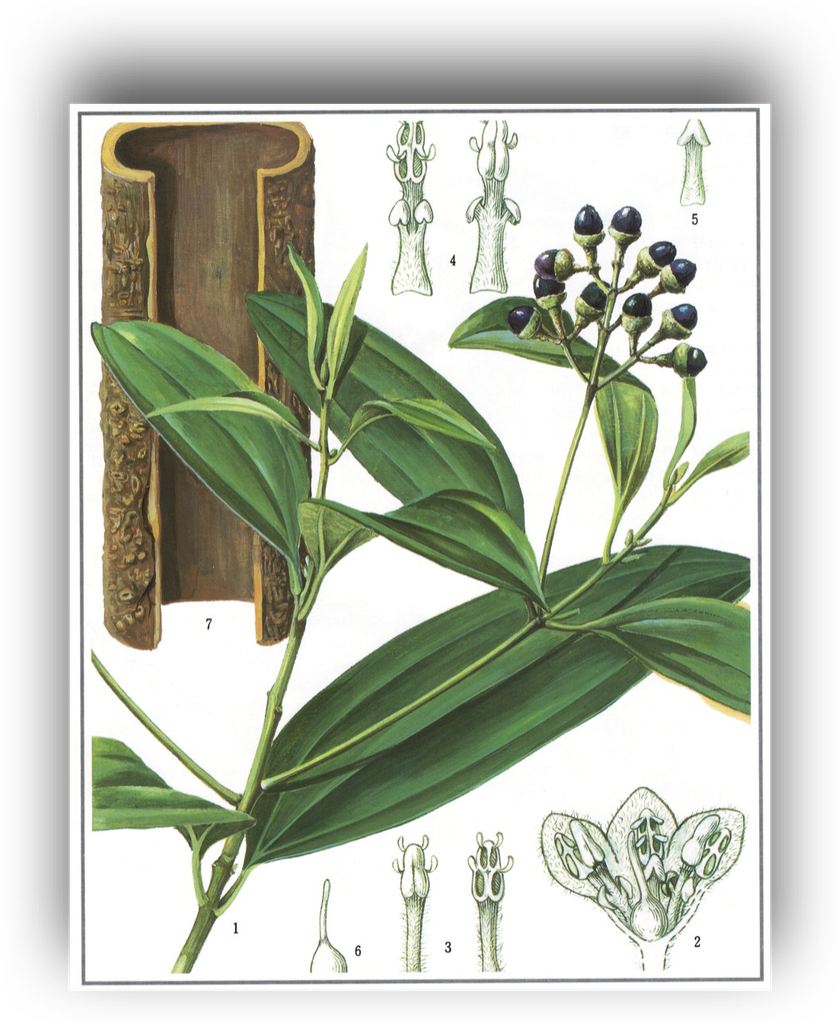
2. CINNAMON TWIG
PIN YIN: GUI ZHI
BOTANICAL NAME: RAMULUS CINNAMOMI
COMMON NAME: CINNAMON TWIG, CASSIA TWIG
The medicinal substance consists of the twigs of the Cinnamon Tree, Cinnamomum cassia Blume (family Lauraceae).
Habitat: Grows in sandy soils or on mountain slopes with good water runoff and prefers rich, sandy loam with high lime and calcium contents—preferably red sandy loam producing an acid reaction (pH 4.5-5.5). The tree likes warm temperatures, high moisture content, and ample sunlight. In Mainland China it grows wild in the provinces of Fujian, Guangdong, Guangxi, and Yunnan.
Flavor: Spicy, Sweet,
Energy: Warm
Meridian: Heart, Lungs, Bladder
Effects: Diaphoretic, antipyretic, stomachic, analgesic, antibiotic, anti-parasitic, anti-viral.
Clinical Use:
1. Scatters Wind Cold:
Used for Wind Cold exogenous fullness pattern. Since Cinnamon Twig Gui Zhi has a weaker diaphoretic effect than Ephedra Ma Huang, it is often combined with Ephedra Ma Huang to enhance its diaphoretic and Cold-scattering ability, as in the Ephedra Decoction Ma Huang Tang. The volatile oils in Cinnamon Twig Gui Zhi have a diaphoretic effect.
If Cinnamon Twig Gui Zhi is combined with a Yin collecting herb such as White Peony Bai Shao which can also harmonize the Nutritional level Ying, then this combination will balance and harmonize the Ying and the Wei levels (the Nutritional and the Defensive), further reducing the herb’s diaphoretic strength. This combination is used in cases of exterior vacuity patterns distinguished by the symptoms of fear of Wind Cold accompanied by sweating, such as in the Cinnamon Twig Decoction Gui Zhi Tang.
2. Warms the channels and scatters cold pathogen:
Used for Wind Cold obstructing the channels leading to pain in the joints of the trunk and the extremities. Cinnamon Twig Gui Zhi has a spicy flavor and its properties are rather warming and moving; it can warm the meridians, scatter Cold, expel Wind, and alleviate pain. With this in mind, anti-rheumatic herbs such as Ledebouriella Fang Feng and Clematis Wei Ling Xian are often added to the Cinnamon Twig Decoction Gui Zhi Tang.
The secondary flavor of Cinnamon Twig Gui Zhi is sweet, which endows the herb with a strong fortifying and invigorating ability—hence its frequent use in gynecology and other non exogenous diseases.
Gynecological conditions such as amenorrhea or dysmenorrhea are often encountered in blood deficient patients in whom pathogenic cold has led to a freezing of the Qi and blood flow. For such conditions, Cinnamon Twig is often prescribed in conjunction with Evodia Wu Zhu Yu, Angelica Sinensis Dang Gui, White Peony Bai Shao, and Ligusticum Wallichi Chuan Xiong as in the Decoction for Warming the Menses Wen Jing Tang.
Cinnamon Twig is also used for palpitations of a blood deficient etiology typified by a knotted and intermittent pulse, often with Fried Licorice Zhi Gan Cao, Codonopsis Dang Shen, and Donkey Hide E Jiao, etc. as in the Fried Licorice Decoction Zhi Gan Cao Tang. These two formulas are examples of the use of Cinnamon Twig Gui Zhi for its meridian-warming and tonifying effect.
3. Moves the Yang and circulates the Qi:
Used for blockage in the circulation of Yang Qi with stopped-up water as seen in edema or congested fluids. As an example, in the Poria Cinnamon Atractylodes and Licorice Decoction Ling Gui Zhu Gan Tang, it treats congested fluids; in the Poria Five Powder Wu Ling San, it treats edema. In both cases, Cinnamon Twig Gui Zhi warms up Spleen Yang, generates circulation of the Phlegm Fluids, facilitates movement of the Bladder energy, and thus transports water.
Dosage: To relieve the exterior, take 2-3 qian. For Wind Damp arthritis of the joints, larger amounts are preferred (4-5 qian).
Contraindications: Cinnamon Twig Gui Zhi is contraindicated for Warm and febrile diseases, Yin deficient or Yang excess patterns, and diseases of the Blood. This is due to the herb’s spicy and warm characteristics that add to the Heat and thus injure the Yin and increase movement of Blood. Use prudently during pregnancy; pregnant women often generate Heat, and there is always the danger of causing a miscarriage. In the absence of heat signs, this caution may be disregarded.
Comparison of effects: Both Cinnamon Twig Gui Zhi and Ephedra Ma Huang can cause sweating, but Ephedra Ma Huang has a stronger diaphoretic effect. The diaphoretic action of Cinnamon Twig Gui Zhi is moderate. Its strength lies in the ability to warm the blood vessels and alleviate pain.
Pharmacological and clinical research:
1. Cinnamon Twig Gui Zhi dilates the capillaries of the skin, increases blood circulation, and stimulates the nerves surrounding (secretion) the sweat glands —hence its diaphoretic and antipyretic effect.
2. Antispasmodic and analgesic effect: It directly affects the sensory center, which increases its analgesic ability. It relieves spasms of the smooth muscles of the internal organs, causes relaxation, and alleviates abdominal pain. It relaxes and dilates blood vessels, thus reducing headaches caused by spasms and constriction of the blood vessels.
Chemical composition:
Contains 0.2% – 0.9% essential oils, with cinnamic aldehyde making up the bulk (70%-80%). Water extractions of cinnamon twig result in transcinnamic acid, coumarin, beta sitosterol, protocatechuic acid, as well as other carboxylic acids. Essential oils .43-1.35% (cinnamaldehyde, benzyl benzoate, cinnamyl acetate, calamenene, β-cadinene, terpinon-4-ol), trans-cinnamic acid, coumarin, protocatechuic acid, 3- (2-hydroxyphenyl)propanoic acid
- Cinnamon Twig Gui Zhi increases the production of saliva, facilitates secretion of gastric juices, aids digestion and has a stomachic effect.